Article
The Era of Flexibility: Why High-Tensile Meshes Are Replacing Reinforced Concrete in Slope Engineering Protection
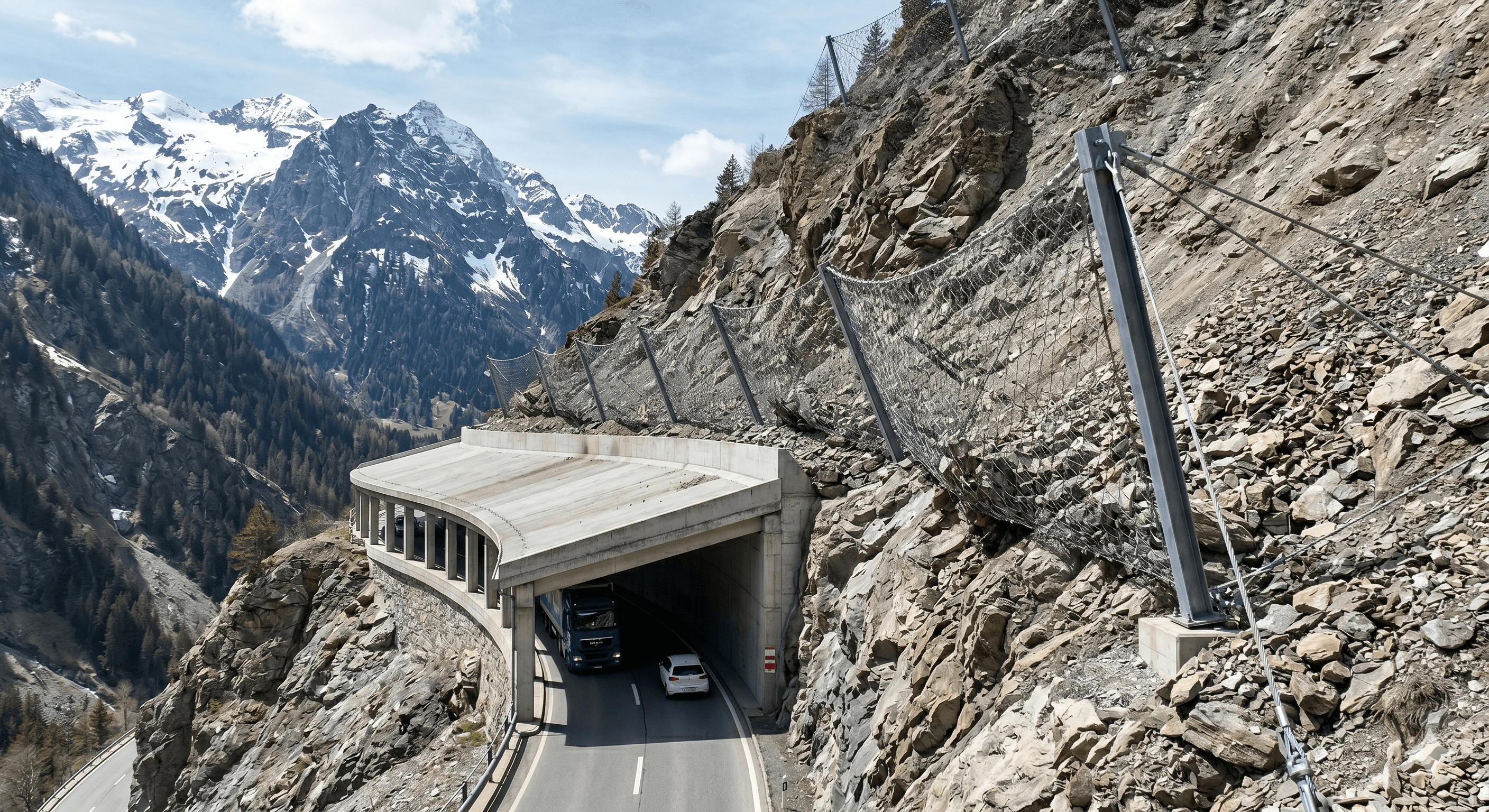
A Paradigm Shift in Geotechnics For decades, massive reinforced concrete structures—avalanche galleries, heavy retaining walls, concrete debris flow catchers, and continuous shotcrete slope facing—remained the only ways to protect infrastructure from avalanches, debris flows, and rockfalls. Today, however, heavy monoliths are being replaced by "flexible" engineering protection: high-tech systems based on ring nets and high-tensile steel meshes (including 2D-Geo slope stabilization systems, catch fences, and debris flow barriers).
This transition is driven not only by advancements in materials science but also by a number of undeniable advantages flexible structures hold over classical reinforced concrete.
1. Impact Physics: Elastic Absorption vs. Brittle Failure The main drawback of reinforced concrete under dynamic loading is its rigidity. Upon direct impact from a multi-ton boulder or a debris flow, a concrete wall absorbs the entire kinetic energy instantaneously. If the energy exceeds its ultimate strength, the monolith cracks and collapses.
Flexible barriers work differently—on the principle of an automotive shock absorber. Through the plastic deformation of the ring net, the activation of energy dissipators, and the elongation of wire ropes, the system extends the impact duration, effectively dissipating colossal kinetic energy (up to 8,000 kJ and beyond). Where a concrete wall would be breached, a steel net will only deform, successfully arresting the flying block.
2. Logistics and Installation in Hard-to-Reach Environments Building a concrete avalanche gallery or dam requires setting up a massive construction site. Access roads for heavy machinery (mixer trucks, concrete pumps, cranes) are necessary, which is often impossible on steep slopes and in high-altitude mountain areas.
Flexible systems are characterized by their modularity and light weight. Drilling operations for anchor installation can be performed using lightweight portable drill rigs by industrial rope access technicians. The delivery of high-tensile mesh rolls and structural posts is easily accomplished by helicopter or cableways. This makes it possible to protect areas with the most complex terrain where heavy machinery simply cannot reach.
3. Slope Hydrogeology: Permeability vs. a "Solid Wall" One of the most dangerous solutions in classical geotechnics is the continuous covering of a slope with shotcrete. By creating a watertight crust, concrete blocks the natural discharge of groundwater. As a result, immense hydrostatic pressure builds up behind the wall, which sooner or later leads to a massive failure of the entire rock mass along with the concrete facing.
Active protection systems like 2D-Geo and mesh draperies are completely permeable. They securely fix unstable rock blocks without disrupting the natural hydrological regime of the slope, entirely eliminating the risk of water pocket formation.
4. Project Economics and Timelines Concrete works demand enormous time investments: formwork preparation, rebar tying, pouring, and, most importantly, waiting for the concrete to cure and gain strength (up to 28 days). In severe climatic conditions (freezing temperatures, precipitation), this process becomes vastly more complicated and expensive.
The installation of flexible barriers and drapery meshes is significantly faster, assembled much like a modular construction set. The systems are ready to bear design loads immediately after tensioning the ropes and tightening the anchor nuts. Rapid installation means minimized road closure times or mine operational halts, which is critical for the profitability of the client's enterprise.
5. Eco-Friendliness and Landscape Integration Reinforced concrete galleries and dams leave indelible visual "scars" on nature. In nature reserves, tourist clusters, and near populated areas, this often becomes a significant issue. Flexible structures are visually transparent. Over time, the steel mesh becomes covered with natural vegetation (especially when used with erosion control mats) and organically blends into the landscape, preserving the aesthetics of the area.
Conclusion Choosing flexible metal structures based on high-tensile meshes is not a compromise, but a technological leap forward. Dynamic barriers and 2D-Geo systems provide higher reliability under extreme dynamic loads, are installed faster, are more cost-effective to implement, and do not disrupt the slope ecosystem. For modern infrastructure projects, flexible protection has long become the number one safety standard.