Article
Slope Engineering Protection: A Comparison of Passive and Active Solutions
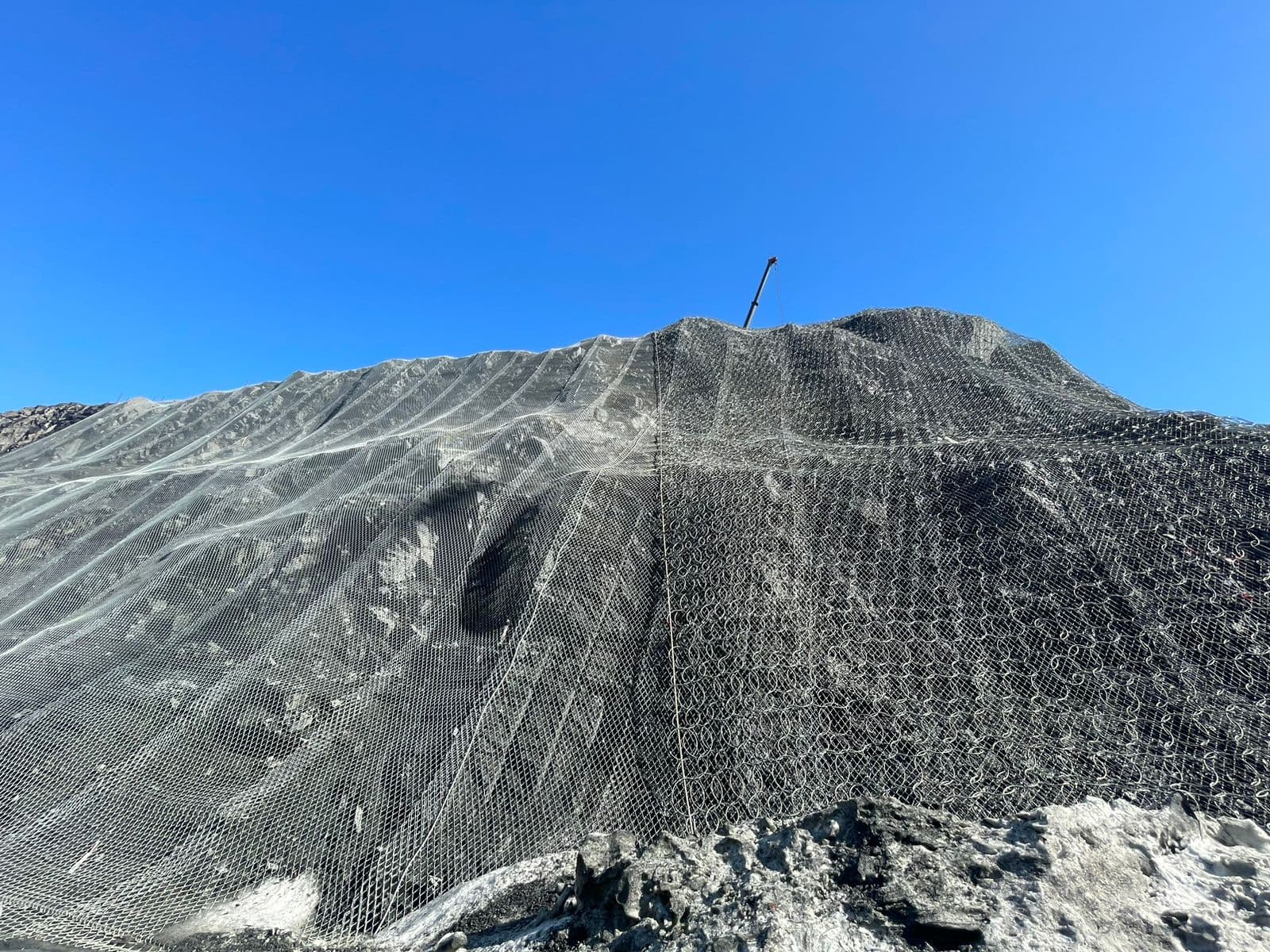
Infrastructure facilities located in complex terrain—railway lines, highways, and industrial sites—require uncompromising protection against rockfalls and landslides. In modern geotechnics, there are two fundamental approaches to the stabilization of rock and soil masses: passive and active. The choice of a specific technology depends on the engineering and geological conditions, slope steepness, and the safety requirements of the protected asset.
Passive Protection: Controlled Descent (Rockfall Drapery System)
Passive systems do not prevent the detachment of rock masses; instead, they take absolute control over their falling trajectory. The slope is draped with a ring net or high-tensile woven mesh, which is securely anchored primarily along the upper crest. Falling rock fragments collide with the mesh, lose kinetic energy, and are safely and directionally guided to the base of the slope—into a catch ditch or behind a protective retaining wall (such as gabions). This is an optimal and cost-effective solution for extended sections featuring highly fractured rock masses and continuous scree.
Active Protection: Preventing Collapses (2D-Geo System)
The primary goal of active engineering protection is to prevent the very occurrence of rock movement. High-tensile steel mesh (the 2D-Geo system) is pressed tightly against the slope surface using a calculated grid of deep soil or rock anchors and specialized toothed spike plates. The mesh transfers the retaining force directly to unstable blocks, rigidly securing them in their original positions. The system functions as a unified structural shell, preventing deformation, and is applied where the falling of even minor rock fragments is unacceptable.
Selection Criteria and Technology Integration
The choice between active and passive protection, or a combination of both, is determined during the design phase. Passive drapery systems are characterized by high installation speeds along extended railway sections. The active 2D-Geo system requires more complex drilling and the use of specialized hardware, but it ensures the stability of critical overhanging sections and can be applied even on waterlogged or wooded slopes to prevent erosion. In practice, solutions are often combined: the upper part of the slope is rigidly fixed with anchors, while lower down, the mesh transitions into a guiding drapery.
Conclusion
Both passive rockfall drapery systems and active 2D-Geo stabilization systems are highly effective tools for ensuring transport and industrial safety. Accurate geotechnical calculations, the correct selection of components (from the load-bearing capacity of the meshes to the type of anchor rods), and professional installation create a reliable barrier that guarantees the uninterrupted operation of infrastructure in the most severe conditions.