Article
Rockfall Protection: Barrier or Drapery? Criteria for Choosing the Optimal Solution
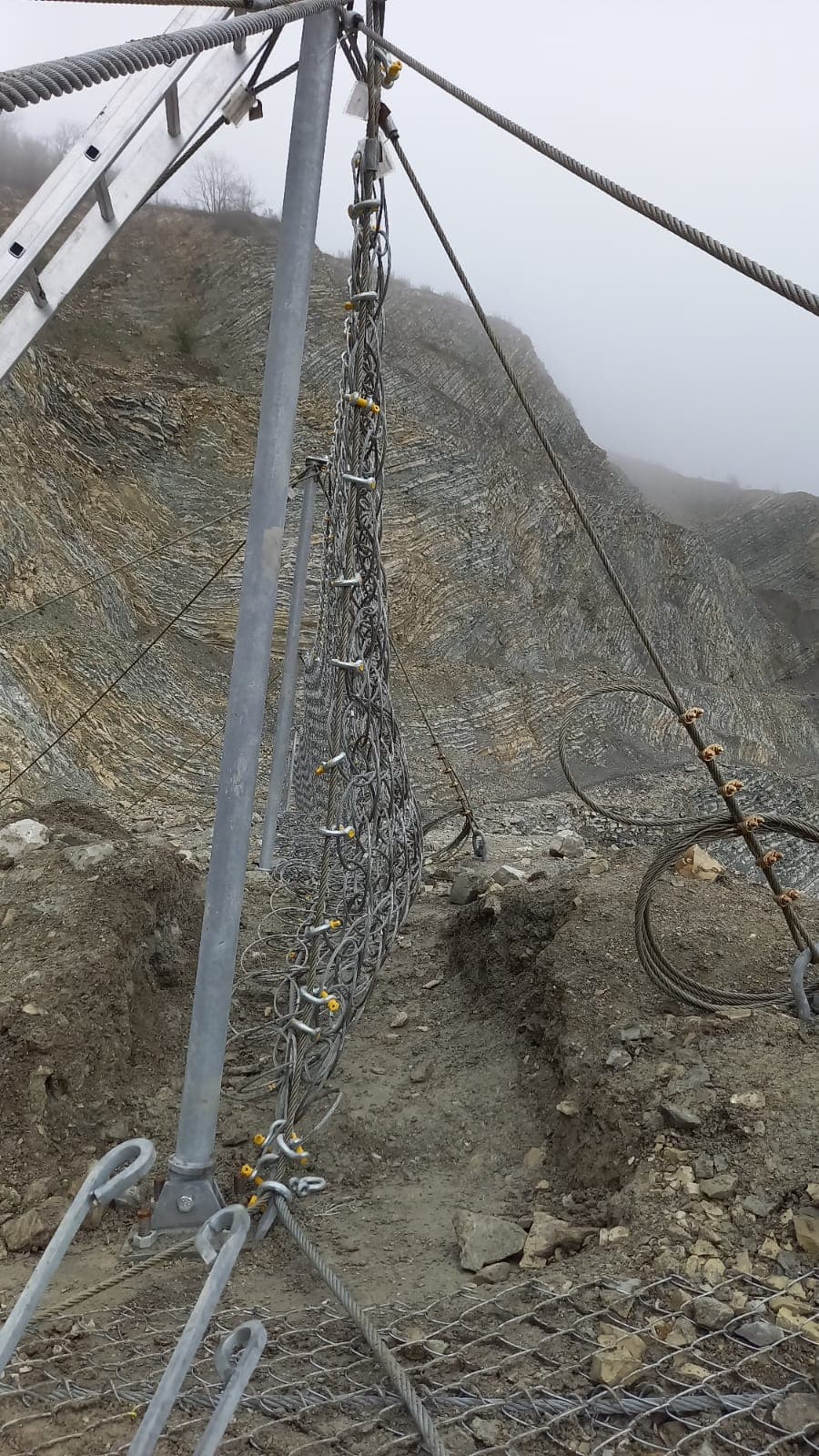
Ensuring the safety of infrastructure facilities in mountainous terrain requires reliable protection against gravitational processes. In modern geotechnics, two primary types of passive protection are used to combat active rockfalls (when preventing rock detachment with anchors is impractical): dynamic rockfall barriers (catch fences) and rockfall drapery systems.
Both solutions have proven highly effective, but they operate on fundamentally different physical principles. Choosing between a barrier and a drapery is not a matter of personal preference, but the result of rigorous engineering and geological calculations.
Rockfall Drapery System: The Principle of Controlled Descent
A drapery is a continuous sheet of high-tensile steel mesh or ring net that is secured at the crest of the slope and left to hang freely.
How it works: The drapery does not attempt to rigidly stop a flying rock. Its function is to "catch" the fragment at the moment of detachment, dissipate its kinetic energy through friction and the net's own weight, and safely and directionally guide it down to the base of the slope.
Ideal application conditions:
Highly fractured rock masses with continuous fine to medium scree.
Extended protection areas (e.g., kilometer-long railway sections).
Primary condition: The presence of sufficient space at the slope's base to construct a catch ditch (trench) or a protective retaining wall (e.g., using gabions) where the descending rock can accumulate for subsequent removal.
Dynamic Rockfall Barrier: The Principle of Impact Absorption
A barrier is a catch-type engineering structure consisting of structural posts, energy-absorbing elements (dissipators), a system of steel wire ropes, and an intercepting panel (ring net). It is installed across the potential rockfall trajectory.
How it works: The barrier absorbs the massive dynamic impact of a rock block traveling at high speed. Through the deformation of the energy absorbers and the elasticity of the ring net, the system dissipates the kinetic energy (up to 8,000 kJ and beyond), bringing the boulder to a complete halt mid-air.
Ideal application conditions:
The threat of large, isolated rock block detachments (boulders weighing several tons).
High kinetic energy of falling debris due to the height and steepness of the slope.
Primary condition: A lack of space at the bottom. If a highway or building is situated directly against the rock face and there is no room for a catch ditch, the barrier is installed higher up the slope to intercept rocks along their transit path.
Comparative Analysis: Which to Choose for Your Facility?
During the design phase, specialists rely on the mathematical modeling of trajectories (calculating bounce height, velocity, and rock energy). The main selection criteria can be summarized by the following factors:
Space at the toe of the slope. If the protected asset (e.g., a conveyor gallery in an open-pit mine or a roadbed) is directly adjacent to the wall, a barrier installed higher up the slope is required. If there is a buffer zone for rock accumulation, a drapery is more efficient.
Weathering characteristics. For slopes that constantly shed small rocks, a barrier is not always practical: its netting will fill up quickly, requiring frequent and complex clearing at height. In this scenario, a drapery acts as an ideal chute, guiding the rock down where it can be easily removed by a loader.
Kinetic energy and block size. If the calculated impact energy exceeds the capacity of a drapery, and the expected boulder size is critically large, only a certified, high-energy barrier can stop it.
Project economics on extended sections. Protecting long linear assets (highways) with a continuous drapery is often more cost-effective and faster to install than a long chain of barriers, which require drilling deep boreholes for every post and anchor.
Conclusion
In modern geotechnics, there are no "bad" or "good" systems—there are only solutions precisely tailored to a specific threat. In complex mining and industrial environments (such as deep open-pit mines or sheer cliffs along highways), engineers often employ a combined approach: locally installing high-capacity ring net barriers along the transit paths of large boulders, while draping areas of intensive scree with guiding mesh systems.
Professional geotechnical slope audits and the competent application of modern high-tensile materials always serve as the ultimate guarantee of safety.