Article
Maximum Rockfall Protection Using Drapery Systems
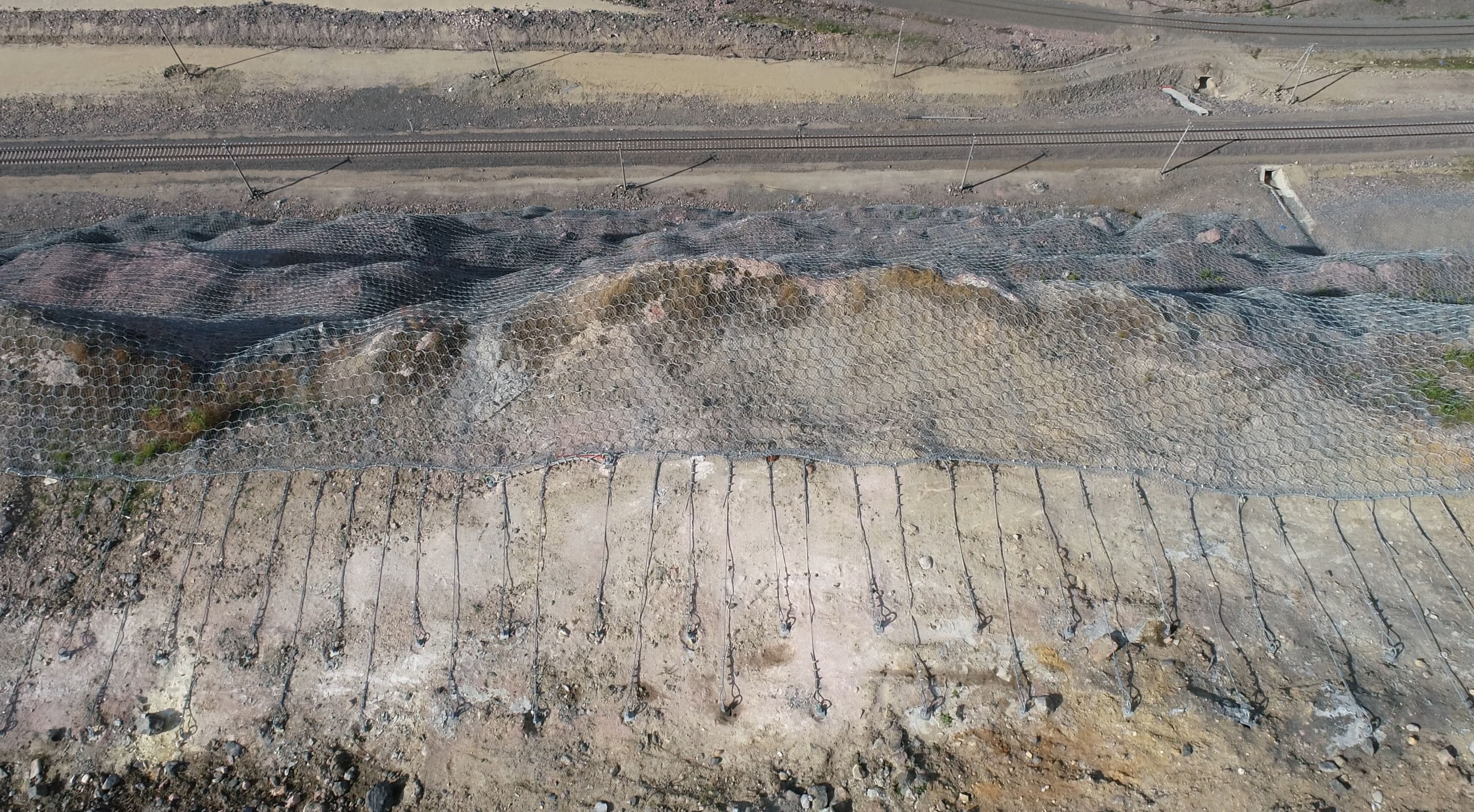
The Threat of Rockfalls to Infrastructure Facilities Mountainous regions and areas with complex terrain pose a constant threat to transport highways, industrial facilities, and power lines. Weathering processes, soil erosion, temperature fluctuations, and seismic activity inevitably lead to the detachment of rock fragments. To protect extensive sections of infrastructure from regular scree and rockfalls, geotechnical engineers utilize one of the most reliable and cost-effective solutions: rockfall drapery systems (passive protection systems).
Operating Principle of a Rockfall Drapery System Unlike active systems that rigidly secure unstable blocks with anchors, a rockfall drapery system operates on the principle of controlled descent. The primary objective of the system is not to prevent the detachment of a rock, but to intercept it at the onset of movement, dissipate its kinetic energy, and safely guide it to the base of the slope.
The slope is draped with a continuous sheet of high-tensile steel mesh or ring net. The mesh is securely anchored at the upper part of the slope (on the crest) using a support cable and anchor line, while the main body of the mesh hangs freely downwards. Falling debris collides with the mesh, loses velocity, and rolls down under its own weight into a pre-prepared safe zone—a catch ditch (trench) or behind a gabion retaining wall.
Applied Materials and Solutions The effectiveness of a rockfall drapery system depends directly on the physical and mechanical properties of the applied mesh. For high-risk facilities, the following are utilized:
Ring Nets: Manufactured from high-tensile steel wire woven into rings. They possess phenomenal energy-absorbing capacity and can withstand impacts from rock fragments weighing several tons.
High-Tensile Meshes (including 2D-Geo): Used for draping slopes with fine to medium scree. They are characterized by high tensile strength and resistance to deformation.
Combined Systems: In areas with intensive weathering of fine fractions, the load-bearing ring or rhombic net can be supplemented with a fine double-twisted mesh to catch even the smallest rocks.
Key Advantages of Using Drapery Systems
Cost-Effectiveness: Drapery systems are the optimal solution for protecting highly extended sections (such as railway lines and kilometer-long highway stretches), as they require a significantly smaller volume of drilling work compared to active systems.
High Installation Speed: The use of rolled materials and modular structures allows work to be carried out within tight deadlines, minimizing the time transport routes need to be closed.
Adaptability to Terrain: The mesh easily contours to the irregularities of the rock mass, creating a continuous protective screen even in areas with complex geometry.
Eco-Friendliness and Aesthetics: Steel meshes feature high light transmission, do not interfere with natural drainage, promote the natural revegetation of the slope, and visually blend into the landscape.