Article
From a Compact Car to a Loaded Dump Truck: Explaining the Capacity of Rockfall Barriers with Simple Examples
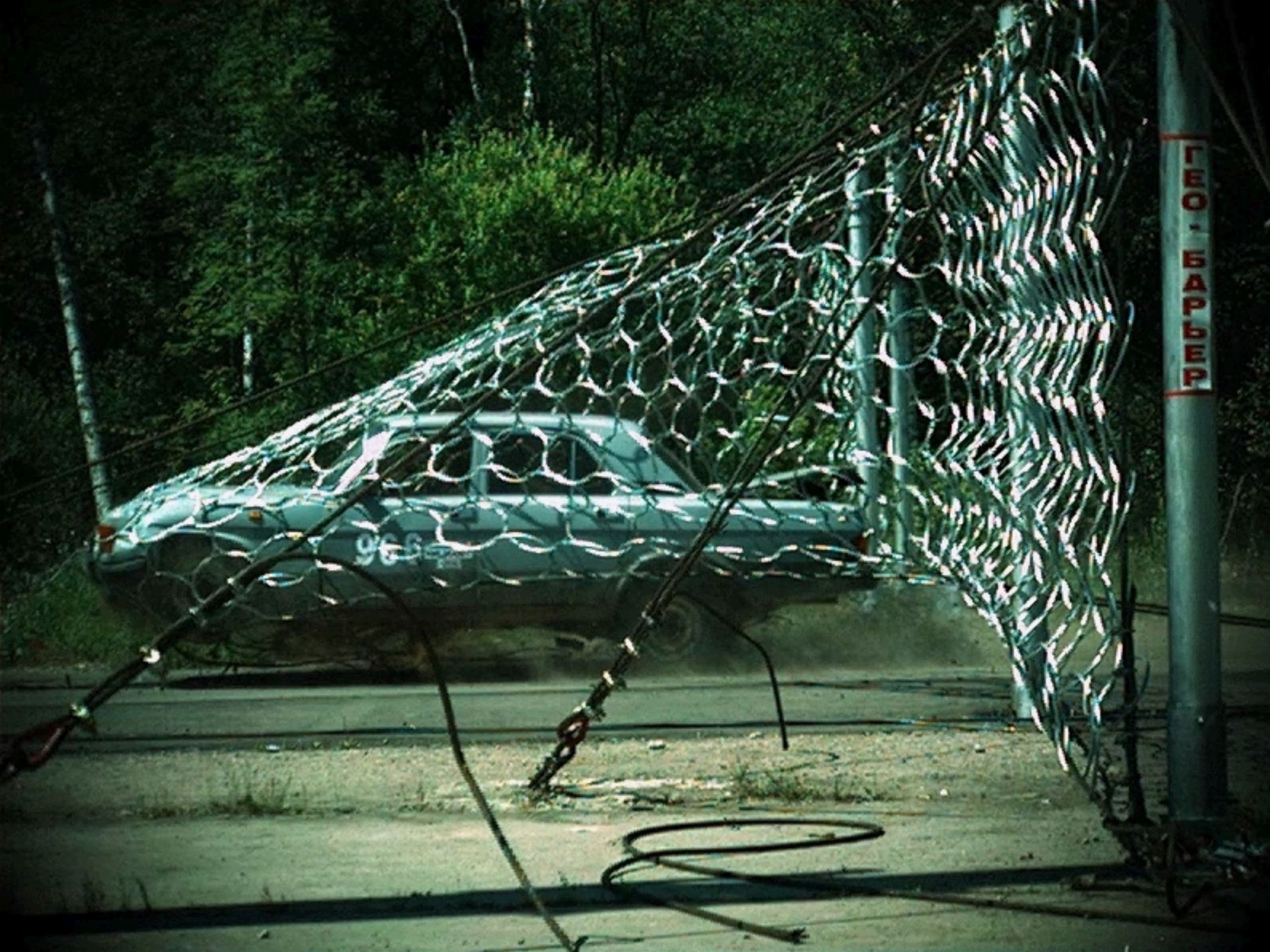
When geotechnical engineers discuss rockfall protection, they constantly juggle acronyms and intimidating numbers: "a 150 kJ barrier," "a 3,000 kJ system," "an 8,000 kJ impact." For an engineer, a kilojoule (kJ) is a perfectly clear unit of energy. But for a layperson or a client who simply wants to secure their road or factory, these figures sound like pure abstraction.
Let's forget about complex formulas. What exactly is kinetic energy? Roughly speaking, it is the weight of a falling rock multiplied by its speed. To stop this destructive power, a barrier doesn't act like a rigid concrete wall (which would simply shatter into pieces); instead, it works like an elastic baseball mitt. The barrier bends, stretches, and its energy dissipators tear with a characteristic crunch, but ultimately, the rock is safely caught and suspended in the net.
To help you easily visualize the difference between our systems, we’ve translated those boring kilojoules into something everyone understands: heavy vehicles crashing at high speeds.
Level 1: GB-150A (150 kJ) — "The Compact Car Shield"
Real-life analogy: Imagine a compact car (like a Toyota Corolla or Honda Civic weighing about 1 ton) crashing into the net at a speed of 60 km/h (37 mph). Alternatively, think of a half-ton (500 kg) rock tumbling down a mountain at 90 km/h.
What the barrier looks like: This is a relatively lightweight structure with a height of 2.5 meters. Instead of massive "chainmail," it utilizes a high-tensile 2D-Geo steel mesh with a rhomboidal cell structure.
What it's used for: It is the ideal solution for small slopes along highways where there are no massive cliffs, but where fine to medium gravel constantly sheds, posing a risk of shattering windshields or causing traffic accidents.
Level 2: GB-1000A (1,000 kJ) — "The SUV Catcher"
Real-life analogy: An impact of this magnitude is equivalent to a large, heavy SUV (like a Toyota Land Cruiser) weighing 2.5 tons slamming into the barrier at full throttle—100 km/h (62 mph). In terms of a rockfall, this means a boulder the size of a utility trailer hurtling down at nearly 97 km/h.
What the barrier looks like: The toys are put away. The structural posts reach 3 meters in height. The netting is upgraded to a true ring net (woven from high-tensile steel rings). The system now incorporates energy dissipators—special devices attached to the wire ropes that act as brakes, uncoiling and stretching under an extreme sudden load.
What it's used for: This is the classic protection for dangerous mountain roads, open-pit mines, and railway sections where there is a risk of large, isolated boulders detaching.
Level 3: GB-3000A (3,000 kJ) — "The Truck Stopper"
Real-life analogy: Picture a medium-sized box truck or a passenger bus weighing 7.5 tons. Now imagine this massive vehicle barreling down at 100 km/h (62 mph) and striking dead center into the net. This is exactly the amount of energy (3 million joules) this barrier is designed to absorb!
What the barrier looks like: This is a monumental structure 5 meters high (almost a two-story building). The posts are made of thick-walled steel pipes, the ring net is woven from multi-strand wire, and the entire system is webbed with heavy-duty steel ropes over 20 mm in diameter. To keep the structure anchored in the ground during such a monstrous impact, long, deep ground anchors are used.
What it's used for: Applied in areas with high, steep slopes where rocks have enough time to gain immense speed, as well as for protecting critical infrastructure (power plants, industrial facilities located directly beneath cliffs).
Level 4: GB-8000 (8,000 kJ) — "The Titan Tamer"
Real-life analogy: The absolute record holder. An impact energy of 8,000 kJ is equivalent to a fully loaded, heavy 3-axle dump truck (weighing 25 tons!) crashing into the barrier at 90 km/h (55 mph) and... stopping mid-air without ever touching the ground behind it. Or, imagine the fall of a giant rock block the size of an entire room.
What the barrier looks like: Six-meter-tall masts, a massive number of energy dissipators, and wire ropes as thick as a human arm. The structural posts in such a system can be hinged—upon impact, they yield forward, helping the ring net to softly "wrap" around the giant boulder and distribute the load so the anchors aren't ripped out of the rock face.
What it's used for: Utilized in the most severe mountain conditions, above deep open-pit mines, and in zones with high seismic and avalanche risks. Where a meter-thick reinforced concrete wall would simply crack and collapse, the GB-8000 acts like a trampoline, saving human lives and multi-million-dollar equipment.
Summary: Why you can't just choose "by eye"
As you can see, a rockfall barrier is not just a chain-link fence. It is a highly complex engineering mechanism. You cannot install a "compact car" barrier (150 kJ) in a place where a "truck-sized" rock (3,000 kJ) might fly—the system will simply be wiped out. Conversely, installing the "Titan Tamer" on a crumbling slope with small rocks is economically unviable.
This is exactly why, before installation, the specialists at Geo-Barrier conduct precise 3D modeling. Using specialized software, they "drop" virtual rocks from your specific cliff to determine their exact velocity and weight at the moment of impact. This ensures that the barrier selected is the exact one guaranteed to stop the threat.