Article
Digital Rockfall: A Review of the Best Software for Simulation and Barrier Selection
Designing engineering rockfall protection has long ceased to rely on intuition. As we have already established, an incorrect choice of barrier energy capacity leads to either unjustified budget overruns or a catastrophic failure. To know exactly where a rock block will fly, at what speed it will hit the net, and how high it will bounce, modern geotechnical engineers utilize powerful software suites for 2D and 3D modeling.
The Foundation of Calculations: Terrain Preparation No software can predict a rockfall without an accurate Digital Elevation Model (DEM). The preparation of initial topographic surfaces, the importing of profiles, and the placement of geodetic marks are traditionally performed in professional GIS and CAD environments, such as ArcGIS Pro or AutoCAD. On large-scale projects with complex geology, engineers often apply Python scripts for parsing, filtering point clouds, and automating the processing of coordinate arrays. Only after an ideal mathematical surface is generated is the data loaded into the calculation simulators.
Rocscience RocFall (Canada) — The Industry Standard The RocFall software suite (available in 2D and 3D versions) is one of the most popular tools in the global geotechnical industry.
How it works: The program allows users to define the shape and mass of the rock, as well as assign coefficients of restitution to the slope (determining how much the ground bounces or dampens the impact).
Advantages: RocFall works excellently with both the classical lumped mass model and the rigid body model. The software generates hundreds of thousands of probable fall trajectories, creating heat maps for kinetic energy and bounce height. This enables engineers to precisely determine the optimal alignment for barrier installation.
RAMMS::Rockfall (Switzerland) — Absolute 3D Realism This software was developed by the legendary Swiss Institute for Snow and Avalanche Research (WSL/SLF)—the very institution that sets global standards in mountain hazard protection.
How it works: RAMMS specializes in highly complex 3D rigid body modeling. You don't just input a mass; you launch a virtual rock with a real, complex shape (a polyhedron) down the slope. It tumbles, rotates, and bounces unpredictably off micro-relief irregularities.
Advantages: The program incredibly accurately accounts for the influence of natural forests on rock trajectories. It also provides detailed data on the block's rotational speed, which is critical when evaluating a direct impact on a ring net.
Rockyfor3D (ecorisQ) — Forest Geometry Another powerful European simulator focused on probabilistic 3D modeling.
Advantages: Rockyfor3D is particularly valued for its advanced vegetation algorithms. The program calculates how much kinetic energy a rock will lose by breaking tree trunks of specific diameters on its way down. It is the ideal tool for designing protection on forested mountain serpentines, preventing over-specification of barriers in areas where the forest absorbs part of the impact.
From Virtual Model to the Real "Geo-Barrier" The ultimate goal of using any of these programs is to obtain two critical figures at the proposed protection alignment: maximum kinetic energy (kJ) and maximum bounce height (m).
These parameters are the key to the equipment catalog: If the software indicates an energy of 80 kJ and a bounce height of 1.5 meters, the client only needs the lightweight and cost-effective GB-150A barrier (2.5 meters high) equipped with a 2D-Geo rhomboidal mesh.
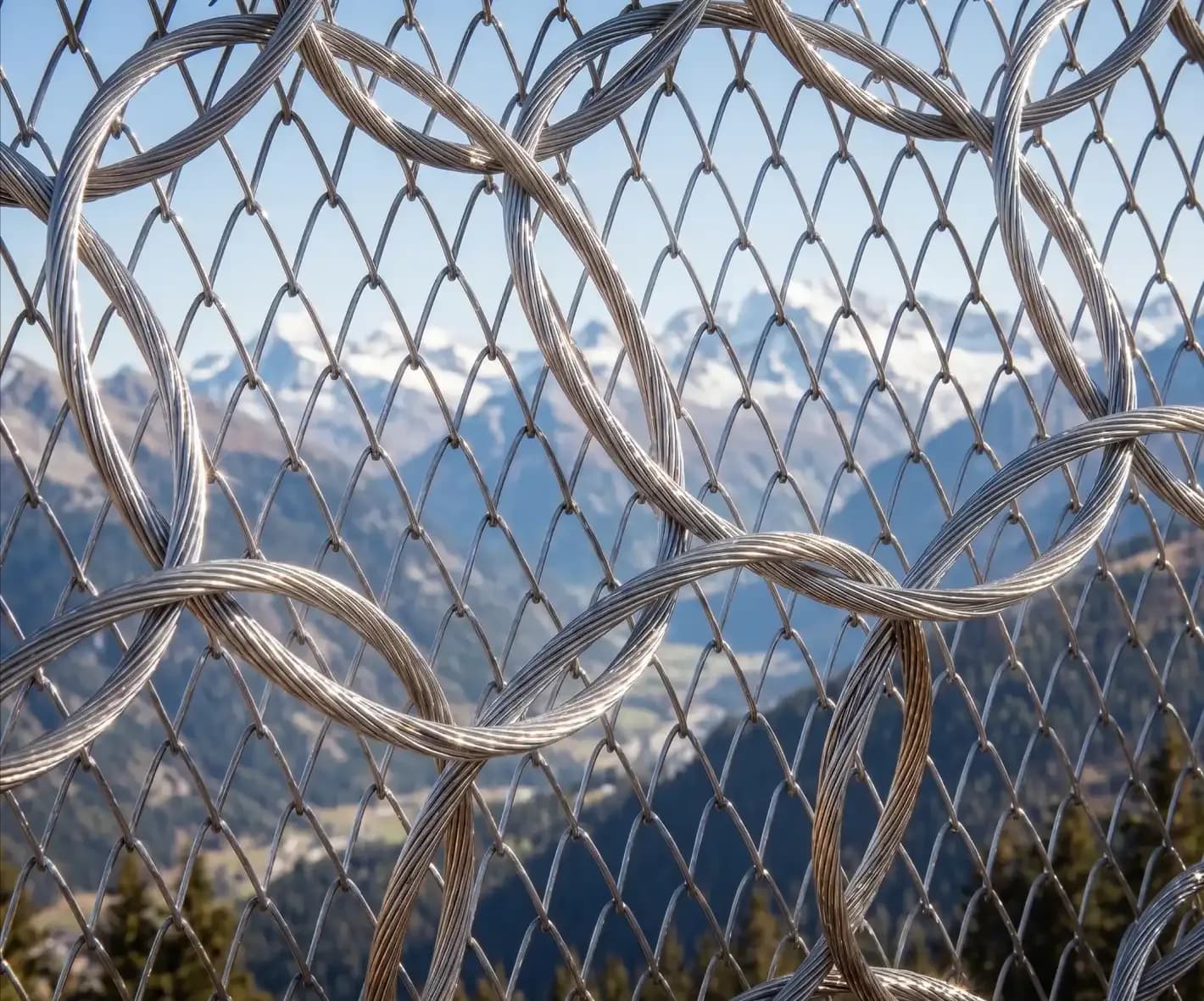
If the 3D modeling results show that a massive boulder reaches an energy of 2,500 kJ and flies at a height of 4 meters, the design engineer must specify the heavy-duty, five-meter GB-3000A barrier, complete with energy dissipators and a reinforced ring net.
Conclusion Using specialized software for the mathematical modeling of rockfalls is not a designer's whim, but the only way to guarantee safety. These programs eliminate human error, help locate the optimal alignment on the slope (where the rock's bounce height is minimal), and allow for the selection of a rockfall barrier that will fulfill its task 100% without excessive overpayments for unnecessary capacity.