Article
Crash-Testing the Rock: How Rockfall Barriers are Tested and Certified in Russia and Worldwide
The design and installation of rockfall engineering protection systems is a field where the cost of an error is measured not only in financial losses but in human lives. This is exactly why the manufacturing of dynamic rockfall barriers is strictly regulated. The client must be absolutely certain that a structure rated for an energy capacity of 3,000 kJ will actually stop a flying multi-ton boulder, rather than collapse under its weight.
To ensure this level of reliability, responsible manufacturers and design engineers rely on stringent international regulations and national standards systems. Let's look at the key regulatory documents that define the rules of the game in the geotechnical market.
The European Gold Standard: EAD 340059-00-0106 (formerly ETAG 027)
Historically, the trendsetters in rockfall protection have been the Alpine countries (Switzerland, Austria, Italy). Their vast experience formed the basis of the world's most famous guideline—ETAG 027, which today has been replaced by the updated European Assessment Document EAD 340059-00-0106.
This standard establishes unprecedentedly strict certification rules. For a barrier to receive the CE marking, it must pass full-scale 1:1 field tests (crash tests) at a specialized testing ground. The standard evaluates two key parameters:
SEL (Service Energy Level): The barrier is subjected to two successive impacts without any repair in between. It must stop the rock and maintain its residual height and functionality.
MEL (Maximum Energy Level): A single impact of massive force. The barrier may sustain serious plastic deformation and some elements may be destroyed, but the primary condition is that the boulder must not penetrate the net and touch the ground behind the catch system.
Swiss FOEN Guidelines
The Swiss Federal Office for the Environment (FOEN/BAFU) maintains its own directive for the approval of rockfall protection structures, which is one of the oldest in the world. Swiss standards largely echo the European EAD but often impose even more severe requirements regarding the corrosion resistance of components and the barrier's behavior under extreme snow loads, which is highly relevant for high-altitude mountain passes.
The Russian Regulatory Framework: Design, Technical Specifications (TU), and Field Tests
Currently, the Russian Federation does not have a single national GOST that completely mirrors the European system and mandates state certification of barriers through full-assembly crash tests. For this reason, the regulatory approach in our country is comprehensive and built on three pillars:
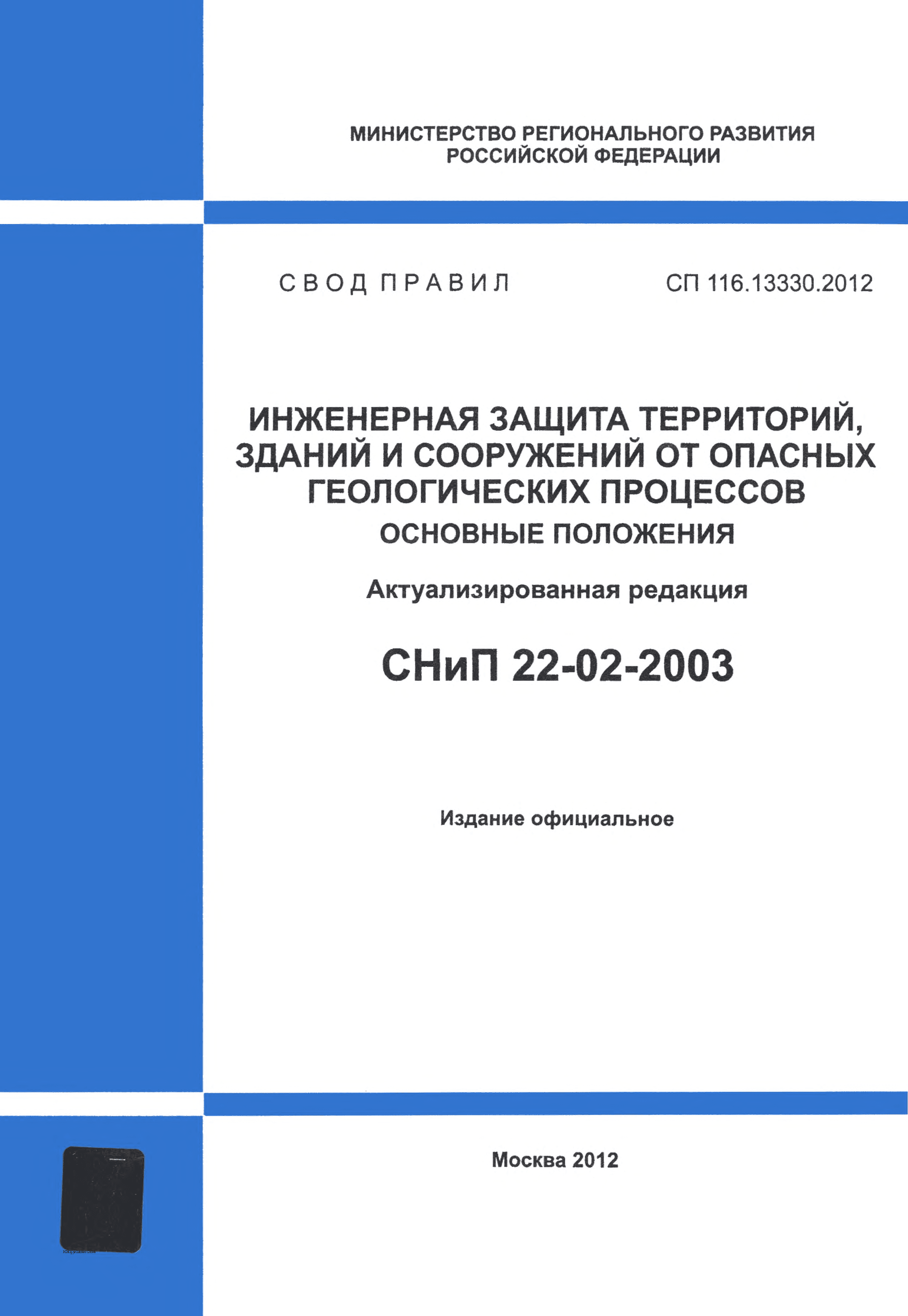
SP 116.13330.2012 (Code of Practice: "Engineering protection of territories, buildings and structures from dangerous geological processes"): This is the primary Code of Practice for design engineers. The document strictly regulates the rules for calculating trajectories, determining the kinetic energy of a flying block, its bounce height, and justifying the choice of passive protection.
Factory Technical Specifications (TU): The quality and load-bearing capacity of the barriers and high-tensile meshes (such as 2D-Geo systems) are guaranteed by the strict Technical Specifications (TU) of the manufacturing enterprises. When developing these specifications, manufacturers rely on fundamental related standards: GOSTs for steel wire, load-bearing ropes, anchor rods, and anti-corrosion protection.
Field Testing and Departmental Guidelines: Leading domestic developers of protection systems conduct their own full-scale tests at proving grounds—dropping standard concrete blocks onto an installed barrier to confirm its energy capacity. Additionally, specific departmental standards are actively applied in the road infrastructure sector, such as the methodological recommendations ODM 218.6.031–2018 issued by Rosavtodor (Federal Road Agency).
Conclusion
Possessing verified barrier characteristics is not just a bureaucratic formality; it is a guarantee that the system will withstand a colossal dynamic impact. In the Russian context, utilizing solutions manufactured under strict Technical Specifications (TU), calculated in strict accordance with SP 116.13330, and verified by real full-scale field tests, allows industrial and transport enterprises to insure themselves against catastrophic risks for decades to come.