Article
Anti-Drone Net: Which Material to Choose for UAV Protection
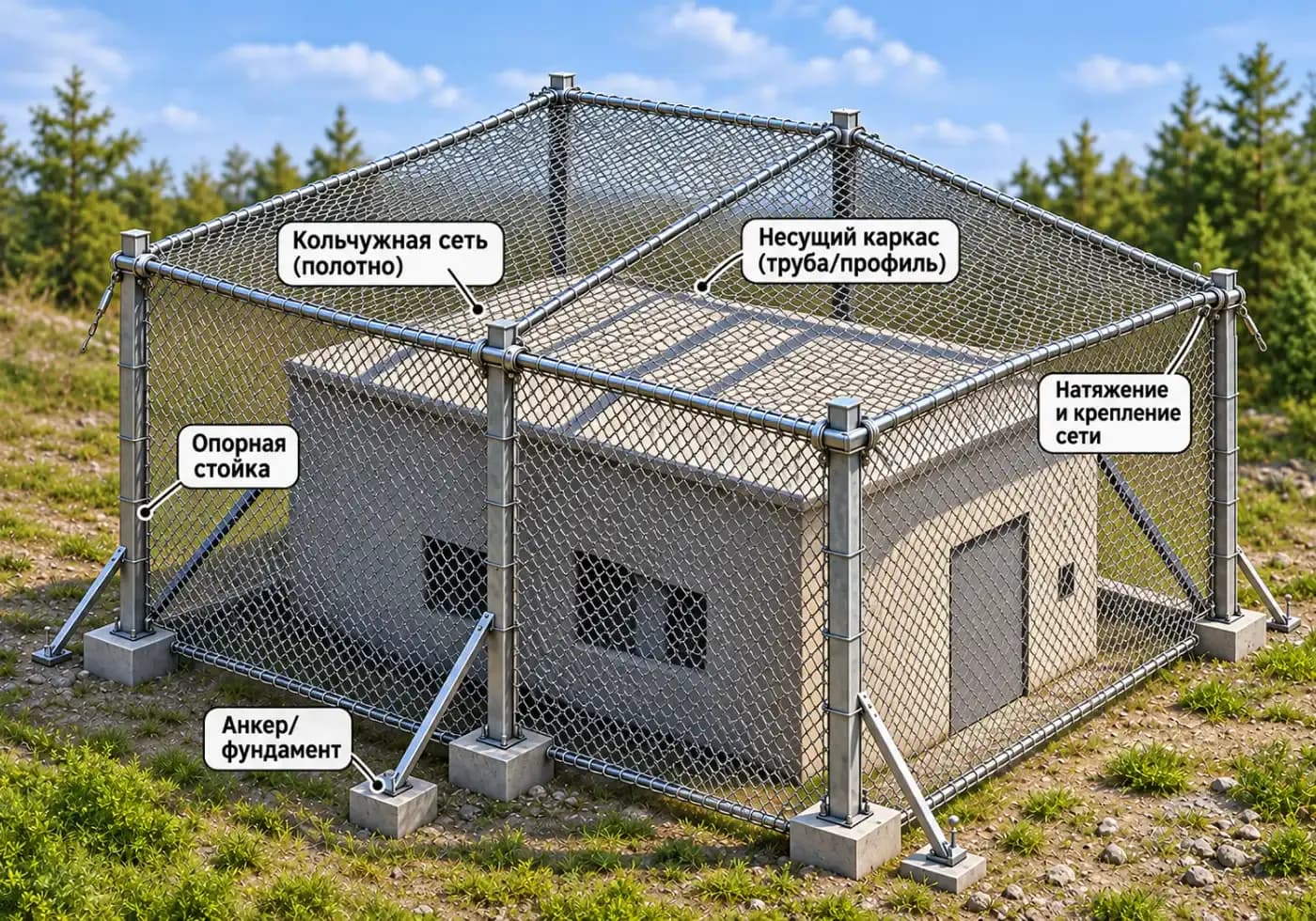
How an Anti-Drone Net Works
An anti-drone net is a physical barrier installed at a distance from the protected structure. A drone or its payload hits the net before reaching the wall, roof, or equipment. The net absorbs the impact energy, catches the device, or deflects the detonation away from the object.
The material determines the most important factors: whether the net will withstand the impact, how many years it will last under sun and wind, and how expensive the protection will be over its entire service life. Therefore, searches for "UAV net," "drone net," and "protective UAV net" today almost always boil down to one question — what is it made of.
Anti-drone nets are used to protect:
-
industrial facilities, storage tanks, and transformer substations;
-
administrative and residential buildings — anti-drone nets for buildings are installed on facades and roofs;
-
windows and glazing — window nets against UAVs protect interiors from shrapnel and direct hits;
-
equipment, communication towers, and utility infrastructure.
Polymer Nets: Polyamide and Polypropylene
Polymer UAV nets are the most common and lightweight option. They are chosen when protection needs to be deployed quickly and temporarily.
Polyamide Anti-Drone Net
Polyamide (nylon) has higher tensile strength than polypropylene and handles impacts better due to its elasticity. It effectively catches light commercial drones.
Weaknesses of polyamide:
-
loses strength under UV exposure, especially without stabilizing additives;
-
absorbs moisture, sags, and requires regular tightening;
-
burns and melts — after an explosion or fire, the cells burn through;
-
easily cut with a regular knife or by cutting elements on the drone's body.
Polypropylene Anti-Drone Net
Polypropylene is cheaper and does not absorb water, so it is often offered when the primary criterion is the anti-drone net price. However, it is inferior to polyamide in strength and sun resistance. Under constant UV exposure, the thread becomes brittle, and at low temperatures, the net loses its elasticity.
Bottom line for polymers: this is a functional temporary anti-drone protection, but not a solution for decades. The net will have to be replaced, meaning you will pay for manufacturing and installation again.
Metal Anti-Drone Nets
A metal anti-drone net is the next step up in reliability. Usually, this is a welded or woven mesh made of steel wire, or a chain-link mesh. Metal does not burn, is not affected by UV rays, and cannot be cut with a knife.
Classic steel mesh has its own limitations:
-
rigidity. Welded mesh poorly absorbs impact: the energy transfers to the nodes, causing the welds to tear;
-
local destruction. A torn cell pulls on adjacent ones, and the hole spreads;
-
corrosion. Thin wire rusts at weld points and where the zinc coating is damaged;
-
complex installation. Rigid panels are hard to fit to the shape of roofs and facades, and mounting anti-drone nets requires a dense framework of supports.
Therefore, a steel UAV net is more reliable than a polymer one, but it still acts as a "wall" rather than a system that absorbs impact. This drawback is eliminated by rope-woven chainmail mesh.
Rope-Woven Chainmail Mesh
Chainmail mesh is a steel wire mesh where each ring is interwoven with adjacent ones, just like in chainmail armor. It has no welded nodes: the impact load is distributed across many rings simultaneously. This technology comes from mountain protection — chainmail rockfall nets have been withstanding the impacts of multi-ton boulders on slopes for years.
Why chainmail weaving outperforms other nets
-
Absorbs impact rather than resisting it. The rings shift and tighten, absorbing the drone's energy. The net works like a shock absorber, not a wall.
-
Does not unravel when damaged. Even if one ring is destroyed, the adjacent ones continue to bear the load. The hole does not grow, unlike in polymer or welded mesh.
-
Cannot be cut and does not burn. A multi-strand steel ring cannot be cut with a knife, and fire or a flash will not burn through the cell.
-
Unaffected by sun, frost, and moisture. A galvanized wire ring does not age from UV exposure, does not become brittle in winter, and does not sag from rain.
-
Flexible and precisely follows the object's shape. Chainmail mesh is easy to stretch over complex roofs, facades, tanks, or equipment.
-
Service life of decades. The net does not require annual replacement and tightening like polymer, and does not rust at the nodes like welded steel.
It is also worth mentioning production. Manufacturing rope-woven chainmail anti-drone nets requires proprietary equipment, wire quality control, and strict manufacturing standards. If you want to buy chainmail mesh directly, choose a chainmail mesh from the manufacturer: this way, you will get a net sized to your facility, a material data sheet, and a product certificate.
More information about the parameters of chainmail nets produced by Geobarrier you can be found here
Comparison of Anti-Drone Nets by Material
For every parameter critical for permanent protection, rope-woven chainmail mesh takes first place.
| Parameter | Polypropylene | Polyamide | Metal (welded, chain-link) | Steel Cable Chainmail Mesh |
|---|---|---|---|---|
| Impact Absorption | Low | Medium | Low, nodes tear | High, rings absorb energy |
| Behavior Upon Breach | Tear spreads | Tear spreads | Hole grows | Damage is localized |
| Cut Resistance | None | None | High | High |
| Fire Resistance | Burns | Burns, melts | Does not burn | Does not burn |
| UV Resistance | Low | Medium | High | High |
| Frost Performance | Becomes brittle | Satisfactory | Good | Excellent |
| Corrosion | None | None | Rusts at nodes | Galvanized wire, no welded nodes |
| Installation Flexibility | High | High | Low | High |
| Service Life | A few seasons | A few years | Medium | Decades |
| Cost Per Year of Service | High due to replacements | High due to replacements | Medium | Lowest |
Installation, Pricing, and Rates
Anti-drone net installation requires no less attention than material selection: even a strong net will fail if mounted incorrectly. Installing anti-drone nets involves calculating the distance to the object, building a support frame, tensioning, and securing the perimeter.
Chainmail mesh simplifies this work. The flexible fabric follows the contours of the roof and facade, and the cable weaving maintains tension without constant tightening. Installation is done once — with no return visits for replacements.
What makes up the price
When comparing how much an anti-drone net costs, people look at the price per square meter. This is a mistake. The correct approach is to calculate the total cost of protection:
-
the cost of the net and its custom manufacturing to the facility's dimensions;
-
anti-drone net installation — the rate for installing the frame and fabric;
-
maintenance: tightening, repairing holes, cleaning;
-
net replacement at the end of its service life — including all costs from items 1–3 all over again.
A polymer net will have to be replaced several times over a building's lifespan. A chainmail net is installed once. Therefore, in estimates and rates for UAV nets, chainmail mesh offers the lowest cost per year of protection.
Conclusion: Which Anti-Drone Net is Best
Rope-woven chainmail mesh outperforms all compared nets in every parameter: impact absorption, survivability upon breach, cut, fire, sun, frost, and corrosion resistance, ease of installation, and service life. Calculated on a per-year basis, it is cheaper than any polymer or welded mesh.
-
Polypropylene and polyamide nets are only suitable as temporary drone protection.
-
Metal welded mesh is stronger than polymer, but poorly absorbs impact and rusts at the nodes.
-
Steel cable chainmail mesh combines the strength of steel and the flexibility of a net — without their drawbacks.
If you need reliable anti-drone protection for buildings and structures for many years to come, choose rope-woven chainmail mesh manufactured by Geo-Barrier LLC.
Contact us to place an order. We’ll advise you and prepare a quote.